About Us
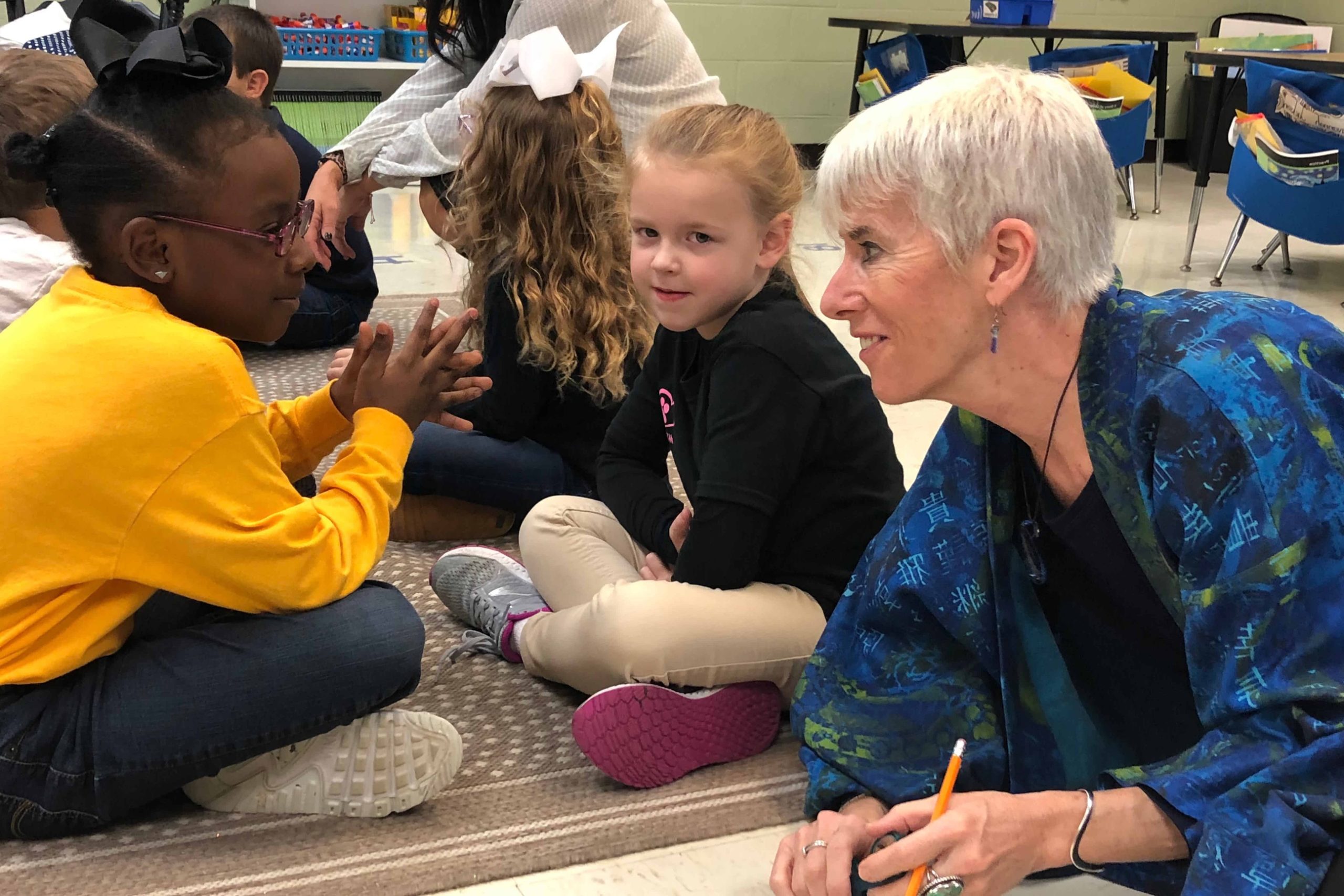

The Knowledge Matters Campaign was launched in 2015 by a group of education thought leaders who understood the essential role of background knowledge to reading comprehension and critical thinking. Almost immediately, hundreds of educators from across the country endorsed the Campaign’s call to “make building knowledge Job One for American education.”
The Campaign initially focused on increasing the instructional time students receive in history, science, geography, art, music, and literature, particularly in the elementary grades. Students in grades K–6 receive a mere 16–21 minutes a day on social studies and 19–24 minutes on science, which defies everything we know from research about the critical role knowledge plays in learning to read and write well.
In recent years, the Campaign has concentrated on how best to inject rich content into the core subjects of English language arts (ELA) and mathematics in the elementary grades, in order to capitalize on the momentum for high-quality curriculum in these two subjects that are the focus of K-12 policy. Our Knowledge Matters School Tour has traveled the country to showcase the promise and excitement around these relatively new, knowledge-building curricula.
The Campaign endeavors to show educators and parents that wonder and excitement CAN be a part of every child’s learning experience. We also seek to cut through the confusion and misinformation about what constitutes excellence in knowledge-building curriculum and to highlight the many virtues of true knowledge-building ELA curriculum, including which ones are the strongest in the eyes of literacy leaders. We will continue to spotlight additional high-quality, knowledge-building curricula as they are developed and to expand the conversation to other disciplinary curricula that support the goal of knowledge-building.
Our scientific advisors
The Knowledge Matters Campaign is fortunate to receive guidance from a distinguished group of education researchers who constitute our Scientific Advisory Committee. While this group is not formally associated with the Campaign and does not endorse—as a group or as individuals—everything said or done via the campaign, we are grateful for their wisdom and humbled by their commitment to advancing our understanding of how children learn to read and write.
The Committee meets quarterly and regularly updates the Campaign about new developments and insights from research, policy, and practice related to how building content knowledge impacts literacy and learning. Members represent a range of scholarly disciplines and areas of expertise, including cognitive psychology, literacy, neuroscience, linguistics, and education policy and practice.
In addition, the Committee has published a guide to relevant research for educators, policymakers, advocates, and the public.
Members of the Scientific Advisory Committee
Marilyn Jager Adams
Visiting Scholar, Brown University
Ana Taboada Barber
Professor and Associate Dean, Research, Innovation and Partnerships, College of Education, University of Maryland
Sonia Cabell
Associate Professor of Education, Florida Center for Reading Research, Florida State University
Hugh Catts
Professor of Communication Science and Disorders, Florida State University
Anne E. Cunningham
Professor, Learning Sciences and Development, Berkeley School of Education, University of California, Berkeley
Nell Duke
Professor of Literacy, Language, and Culture and in combined Program in Education and Psychology, University of Michigan
Lily Wong Fillmore
Professor Emerita, Graduate School of Education, University of California, Berkeley
James S. Kim
Professor, Language and Literacy, Graduate School of Education, Harvard University
Danielle McNamara
Executive Director, Learning Engineering Institute, Arizona State University
Kate Nation
Professor of Experimental Psychology, University of Oxford
Susan Neuman
Professor, Early Childhood and Literacy Development, Steinhardt School of Culture, Education, and Human Development, New York University
Kathleen Rastle
Professor of Cognitive Psychology, Royal Holloway University of London
Pamela Snow
Professor of Cognitive Psychology, School of Education, La Trobe University
David Steiner
Executive Director, Johns Hopkins Institute for Education Policy
Dylan Wiliam
Emeritus Professor of Educational Assessment, UCL Institute of Education
Daniel Willingham
Professor of Psychology, University of Virginia
Scientific Advisory Committee research guide
Adams, M. J. (2011). Advancing our students’ language and literacy: The challenge of complex texts. American Educator, 34(4), 4-11, 53. American Federation of Teachers. https://www.aft.org/sites/default/files/Adams.pdf
This article focuses on the special difficulty exhibited by U.S. students in understanding complex text and discusses causes of and solutions to this problem.
Best, R., Ozuru, Y., Floyd., R., & McNamara, D.S. (2006). Children’s text comprehension: Effects of genre, knowledge, and text cohesion. In S. A. Barab, K. E. Hay, D. T. Hickey (Eds.), Proceedings of the Seventh International Conference of the Learning Sciences (pp. 37-42). Mahwah, NJ: Erlbaum. https://repository.isls.org/handle/1/3525
This study examines reading comprehension in 4th grade students as a function of text genre, students’ prior knowledge, and text cohesion.
Castles, A., Rastle, K., & Nation, K. (2018). Ending the reading wars: Reading acquisition from novice to expert. Psychological Science in the Public Interest, 19(1), 5–51. https://journals.sagepub.com/doi/full/10.1177/1529100618772271
This article provides a comprehensive review of the science of learning to read, spanning the arc of a child’s acquisition of alphabetic skills to the fluent text comprehension characteristic of skilled readers. It argues for a classroom approach to reading instruction that is developmentally-informed and addresses the wide range of knowledge and skills needed to become a reader.
Catts, H. W. (2021-2022). Rethinking how to promote reading comprehension. American Educator. American Federation of Teachers. https://www.aft.org/ae/winter2021-2022/catts
Reading comprehension is unlike other aspects of reading in that it is not a skill that can be reduced to a single score or improved by short-term instruction/intervention, this article argues. Rather it is a condition that is created by teaching fundamental reading skills in a content-rich integrated curriculum that provides background and language knowledge.
Cunningham, A. E., & Stanovich, K. E. (1998). What reading does for the mind. American Educator, 22, 8-17. American Federation of Teachers. https://www.aft.org/sites/default/files/cunningham.pdf
Exposure to print (reading volume) is a unique experiential factor, like schooling, that has long-term cumulative effects. A series of studies are described, which examine reciprocal effects of experience and schooling in children’s early reading development and evaluate the subsequent cognitive consequences of differences in the volume of reading among individuals.
Duke, N. K., Ward, A. E., & Pearson, P. D. (2021). The science of reading comprehension instruction. The Reading Teacher, 74, 663-672. International Literacy Association. https://doi.org/10.1002/trtr.1993
This article addresses the question, “What have decades of research told us about the nature of comprehension and how to develop students’ comprehension in schools?” and presents a layered model of reading comprehension instruction with knowledge building at the center.
Goldenberg, C. (1991). Instructional conversations and their classroom applications. NCRCDSLL Educational Practice Reports. UC Berkeley: Center for Research on Education, Diversity and Excellence. https://escholarship.org/uc/item/6q72k3k9
“Instructional conversations” are discussion-based lessons geared toward creating opportunities for students’ conceptual and linguistic development. They are intended to help students use knowledge and skills to understand, appreciate, and grapple with important ideas.
Hwang, H., Lupo, S. M., Cabell, S. Q., & Wang, S. (2021). What research says about leveraging the literacy block for learning. Reading In Virginia, XLII (2020-2021), 35-48. https://heyzine.com/flip-book/cf84416713.html
This article describes what it looks like to infuse science and social studies content into English language arts instruction in K-5 classrooms. Four high-impact knowledge-building practices are discussed: (1) plan units around content concepts, (2) use conceptually coherent text sets, (3) design hands-on activities in connection with reading, writing, and discussion, and (4) teach vocabulary using categorical relations among words.
McNamara, D. S., & Kendeou, P. (2011). Translating advances in reading comprehension research to educational practice. International Electronic Journal of Elementary Education, 4, 33-46. https://iejee.com/index.php/IEJEE/article/view/212
This publication explores a few key findings on reading comprehension for educators, including how comprehension assessments may miss aspects of readers’ comprehension abilities and how inferencing (and practice doing so) is integral to (improving) comprehension.
Taboada Barber, A. & Lutz Klauda, S. (2020). How reading motivation and engagement enable reading achievement: Policy implications. Policy Insights from the Behavioral and Brain Sciences, 7(1), 27-34. https://journals.sagepub.com/doi/pdf/10.1177/2372732219893385
Reading motivation and engagement are malleable and shaped by children’s environments at school and at home. This article addresses practices that teachers and other practitioners can use to promote motivation in the classroom to boost reading achievement and foster lifelong readers.
Willingham, D. T. (2017, November 25). How to get your mind to read. New York Times. https://www.nytimes.com/2017/11/25/opinion/sunday/how-to-get-your-mind-to-read.html
The article makes the case for the importance of background knowledge for comprehension.
Willingham, D. T., and Hirsch Jr., E. D. (2026). “Rediscovering Knowledge as the Key to Reading: Two champions of knowledge-rich instruction reflect on its current momentum.” Education Next, 26(1), 24 March 2026.
This article explains how educators are returning to the idea that background knowledge plays a central role in comprehension and critical thinking, after decades of emphasizing transferable reading strategies. The authors argue that carefully sequenced, knowledge-rich curricula can improve not only reading outcomes but also learning across subjects, particularly for students with fewer opportunities to build knowledge outside of school.
Our leadership
The Knowledge Matters Campaign is a project of StandardsWork, Inc., a non-profit “do-tank” founded in 1992 that is focused on three high-impact levers for producing academic improvements:
- The vital role high-quality curriculum plays in delivering content and teaching skills.
- The importance of building deep background knowledge in students.
- The “octane” that specific evidence-based instructional practices provide educators.
The Knowledge Matters Campaign is at the intersection of these important objectives and StandardsWork is proud to support its ongoing work. Barbara Davidson, Executive Director of the Knowledge Matters Campaign and President of StandardsWork, can be reached at bdavidson@standardswork.org.